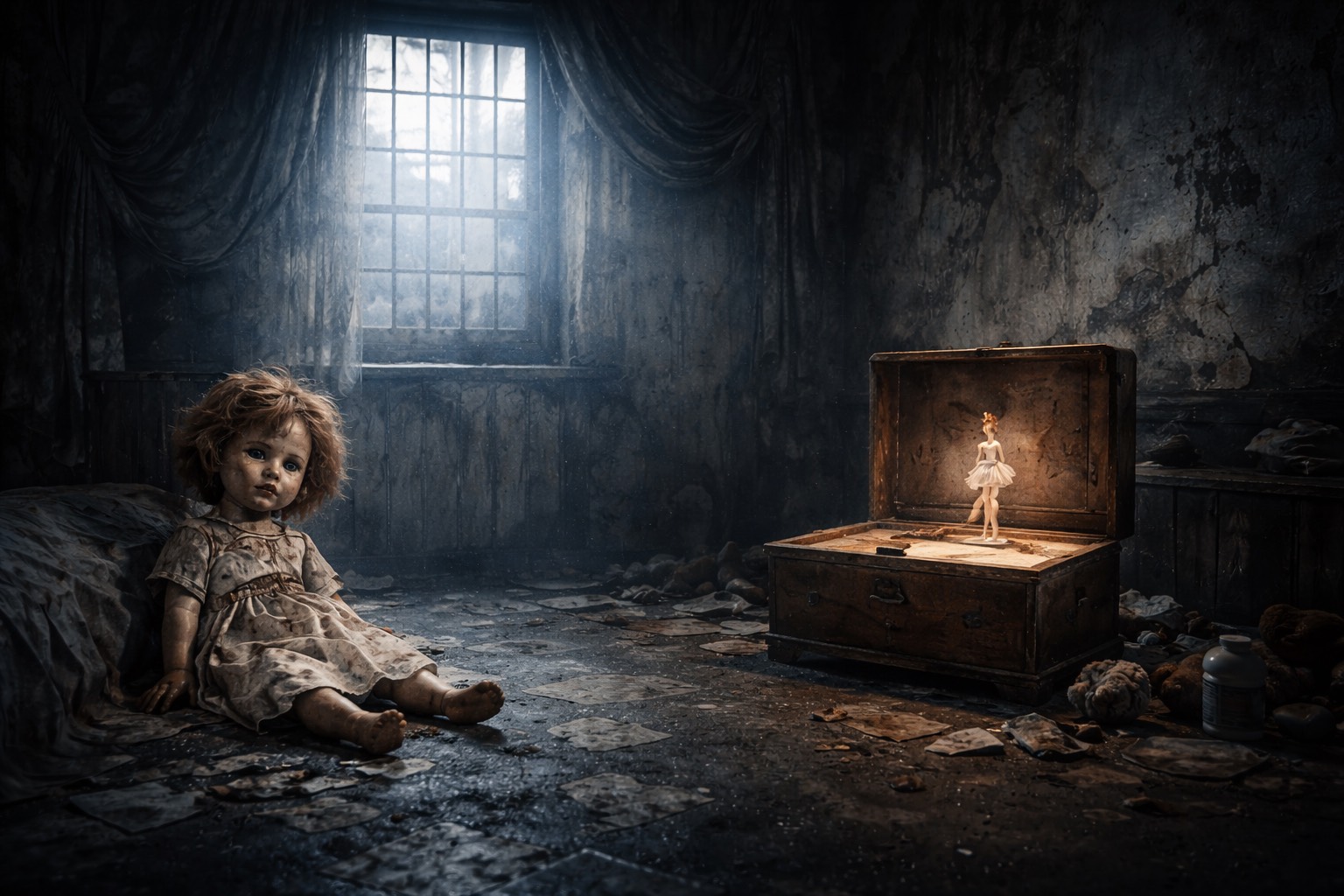
Psychological horror doll book readers don’t fear the doll itself—they fear what it reminds them of.
A doll is small. Quiet. Harmless.
And that’s exactly why it works so well in psychological horror.
In this post, you’ll learn why doll-based dread hits so hard, how to spot it in a story, and why Dark Lullaby belongs on your list if you crave slow, intimate terror.
Table of Contents

Why a psychological horror doll book feels “too real”
Dolls trigger a specific kind of discomfort because they mimic human features without being human.
This sits close to what researchers and writers often describe as the “uncanny valley.” If you want a quick explanation, read the uncanny valley overview (external link).
In horror, that discomfort becomes a weapon.
The doll is a stand-in for memory, childhood, and vulnerability—then the story twists those meanings until comfort becomes threat.
9 wicked reasons dolls terrify adult readers
1) Dolls look like witnesses
A doll doesn’t blink. It doesn’t look away.
That stillness feels like being watched, even when you know you’re alone.
2) Dolls turn nostalgia into dread
Childhood objects are supposed to be safe.
When they become unsettling, it feels like reality itself has been corrupted.
3) Dolls make silence loud
In psychological horror, silence is never neutral.
A doll in a quiet room gives your brain something to fear—without anything actually happening.
4) Dolls suggest a missing person
A doll implies a child, a caretaker, a past life.
Even if none appear on the page, the implication lingers like a stain.
5) Dolls distort identity
Dolls are “almost” people, but not quite.
That “almost” is perfect for stories about unstable perception and unreliable reality.
6) Dolls are props for control
Dolls can be positioned. Stored. Hidden. Returned.
In horror, that creates a brutal question: who placed it there, and why?
7) Dolls weaponize repetition
When a doll appears again and again, it becomes a pattern.
Patterns are terrifying because they feel intentional.
8) Dolls make you doubt yourself
“Was it facing the other way?”
That tiny uncertainty is psychological horror’s heartbeat.
9) Dolls turn love into fear
Many dolls are given as gifts.
So when they become sinister, the fear is emotional—not just visual.
Psychological horror doll book energy in Dark Lullaby (spoiler-free)
Dark Lullaby uses doll-dread the smart way: as an emotional anchor, not a cheap jump scare.
The story’s institutional atmosphere, routine pressure, and memory instability create the same feeling readers describe in “can’t trust what I’m seeing” horror.
If you want the deeper craft angle, read our internal guides:
For a grounded, real-world perspective on how fear and stress can shape perception, the APA has useful starting points here: APA: Stress (external link).
Reading tips to amplify the fear
Want this to hit harder?
- Read in short bursts (1–3 chapters). Dread stays sharper.
- Keep one dim light on. Total darkness can distract from the mood-building.
- Pause when a detail repeats. Repetition is never accidental in this style.
- Don’t skim “quiet” scenes. That’s where the tension is planted.
If you’re on the fence, start here: Read a sample chapter.
If you’re ready, go straight to: Get the full book.
Quick FAQs
Is this book heavy on gore?
No. It’s atmosphere-first psychological horror.
Is it more horror or thriller?
It reads with thriller momentum, but the goal is horror: unease, doubt, and lingering dread.
Why do dolls work so well in adult horror?
Because they twist nostalgia, identity, and helplessness into something you can’t easily rationalize away.